Lake District, Raven Crag, 17-18 July 2026
We came here almost three months ago, on 18–19 April. On the morning of 19 April we made our way beneath Raven Crag and started climbing the rocks...
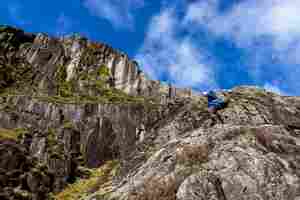
The climbing here is fairly straightforward; we did this route with Sonya years ago, when she was nine years old.
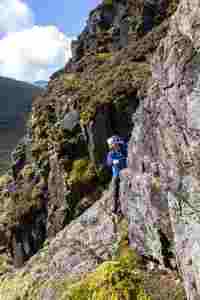
Sudddenly Maria lost her footing on the rock, slipped down, and tumbled for about 70 metres, first over the rocks and then across the grass. She was finally thrown onto a boulder field, where she came to a stop. By some miracle her internal organs were unharmed, but she suffered multiple fractures to her spine, broke a couple of ribs, bruised a lung, and sustained deep cuts to her head. Then there was the mountain rescue team, the helicopter, Royal Preston Hospital, and surgery. And now, just three months later, Maria has recovered so well that we were able to return here and even climb 1000 metres in a single day.
The blue and red lines show our tracks on the 17 and 18 July. Shift-click a track link to open it in nakarte.me.
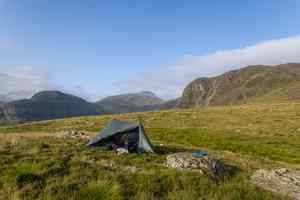
We spent the night in exactly the same spot as we had three months earlier.
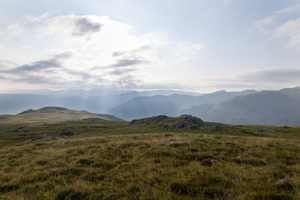
The sun breaks through the clouds from time to time. The Lake District has a quiet, understated beauty. The weather is ideal for walking: pleasantly warm, with occasional sunshine and a light breeze.
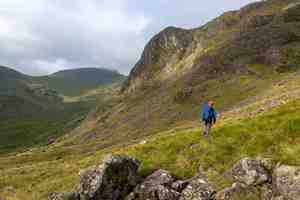
We walked to the foot of the crag to see exactly where everything had happened (move the mouse over the photograph to see the caption). Afterwards we climbed Grey Knotts along a good path.

England is in the grip of a drought. There has been no rain for more than a month. Even in York the grass on the lawns has turned completely yellow. As we drove towards the Lake District, we noticed that everything here was much greener than at home. The Lakes are never as vividly colourful as Alpine meadows, but if you look closely, there are plenty of beautiful wildflowers here too. Right now, common heather (Calluna vulgaris), also known as ling, is coming into bloom.
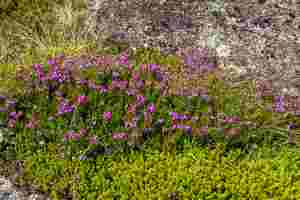
Bell heather (Erica cinerea).

Hard fern or deer fern (Blechnum spicant).
 |
 |
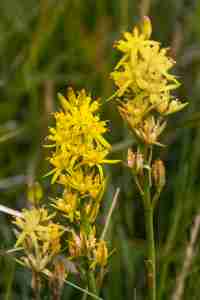
Bog asphodel (Narthecium ossifragum). |
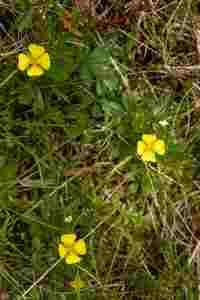
Tormentil (Potentilla erecta). |

Common butterwort (Pinguicula vulgaris), an insectivorous plant native to this part of the world.

The lichen Tephromela atra: the profile of a young woman.
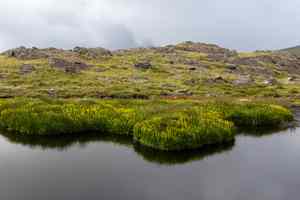
The small tarn on the plateau reflects the yellow flowers of the bog asphodel.

At the edge of the world.

At times the clouds swallowed everything around us, only to rise again and let patches of sunshine through.

Ennerdale framed by a gap in the clouds.
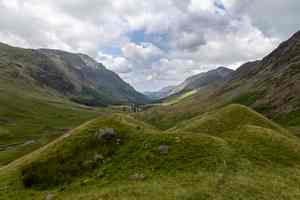
We descended into the valley and stopped to rest before the final climb, not far from the hostel.
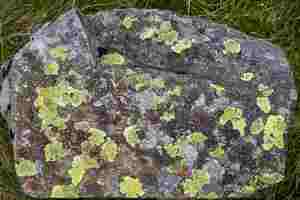
Another boulder decorated with map lichen, Rhizocarpon geographicum.
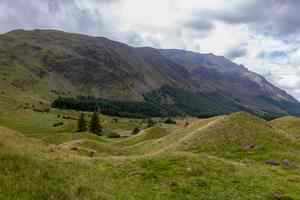
We like these little hummocks in the upper Ennerdale valley. They were left behind when the glacier melted here thousands of years ago.
We had a wonderful weekend walk: we saw the Lake District in summer, revisited some of our favourite places, and realised that there is still so much ahead of us.


